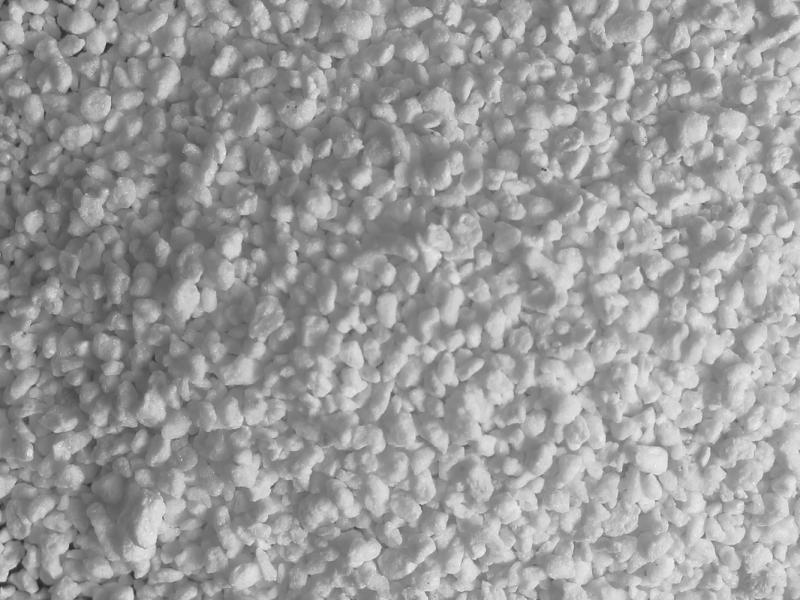
WLS 045 expanded perlite loose-fill insulation
Insulation boards
Plaatisolatiematerialen
Plattendämmstoffe
Mats for thermal insulation
Mattenisolatiematerialen
Mattendämmstoffe
Loose-fill and blow-in insulation materials
Stort- en inblaasisolatiematerialen
Schütt- und Einblasdämmstoffe
Speciality products
Speciale producten
Spezialprodukte
Eigenschaften
Owing to its mineral origin, expanded perlite is resistant to pests and also age-resistant. Its water-repellent properties and free-flowing nature make it ideally suited for use in retrofit core insulation. Only a few drill holes are required for this. However, its free-flowing nature can also pose a problem, so you should ensure that the masonry is sealed before installation. Furthermore, you should protect yourself from the dust generated when installing the insulation material.
The material can simply be poured into the insulation space and, if necessary, lightly compacted. Expanded perlite is primarily used for insulating cavities and beneath screeds.
Rohstoffe und Herstellungsverfahren
Raw materials: Perlite (volcanic rock), water-repellent agent
The volcanic rock is ground and briefly heated to 1000°C. This causes the water naturally present in the material to evaporate, causing the product to expand (similar to popcorn popping). The product is then impregnated to give it water-repellent properties.
Technical Specifications
Property | Unit | Parameters | |||
|---|---|---|---|---|---|
| Additives | Silicone impregnation (core insulation) | Silicone impregnation where applicable | Bitumen | Bitumen | |
| Thermal conductivity λB | W/(mK) | 0.045 | 0.05 | 0.060 | 0.065 |
| Bulk density ρ | kg/m³ | 83–85 | 85–145 | 165 | 190 |
| Heat storage capacity c | J/(kgK) | 1000 | 1000 | 1000 | 1000 |
| Building material class | -- | A1 | A1–B1 | B2 | B2 |
| Water vapour diffusion resistance μ | -- | 3 | 3 | 3 | 3 |
| Primary energy content | kWh/m³ | 200–240 | 200–240 | 200–240 | 200–240 |
| Water-repellent effect | -- | yes | Depends on the product | N/A | Depends on product |
| Can it withstand pressure? | -- | Depends on the product | Depends on the product | High | high |
*Comparative U-value: 1.0 W/(m²K)
Additive-free expanded perlite may be used for soil improvement in horticulture and agriculture. Otherwise, the material must be disposed of as construction waste.
European approvals
Legal provisions: §§:
Blown-in insulation for double-skin masonry is only considered insulation within the meaning of building regulations if it has been installed by specialist contractors who have been trained in its use by the relevant manufacturer and are included on a list. If installed by a DIY enthusiast themselves, the material will provide insulation but is not legally classified as insulation. In the event of damage (e.g. fire), this could lead to problems with insurance companies. Furthermore, any subsidies are not available for structures in which self-installed blow-in insulation has been used. Even in the case of ‘KfW-x buildings’ or new builds, these insulation materials must not be included in the calculations made by energy consultants or architects.
This rule does not apply to loose-fill perlite in timber-beam ceilings or similar structures.
Gesundheit und Ökologie
Pure expanded perlite can be considered harmless to health. Theoretical concerns regarding radioactive contamination have not been confirmed by studies. The raw materials are readily available. However, the material is mined in Southern Europe and South America[i], resulting in long transport distances. Furthermore, energy is required to expand the material. Impregnation leads to a deterioration in the environmental performance. In the event of a fire, toxic substances may be released from bituminous products.
- extensive experience in working with the insulation material
- Raw material readily available (natural resources)
- Wide range of applications
- Seamless adaptation to cavities
- partly non-combustible
- dusty
- Material settles
- Risk of run-through
- Use of additives
- only moderate insulation values by comparison