Image

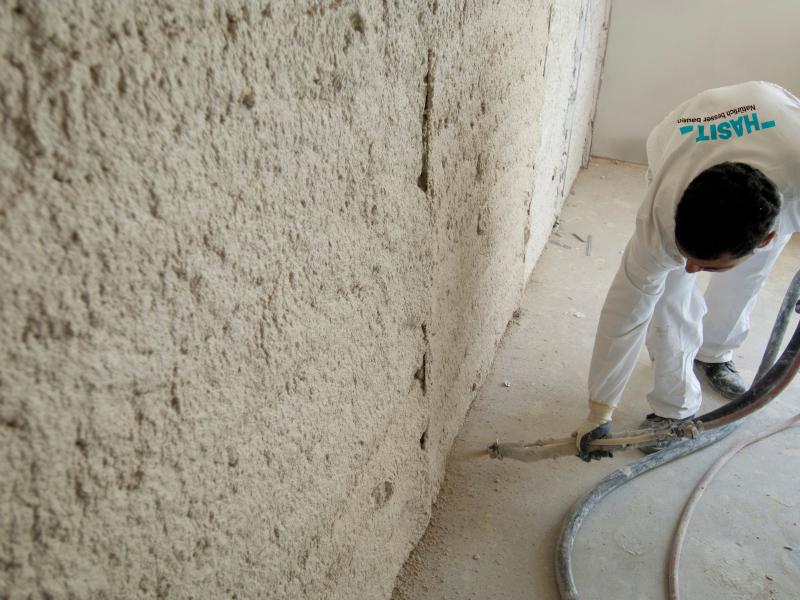
Fixit 222 Aerogel High-Performance Insulating Plaster is an innovative insulating plaster: by using aerogel granules as an insulating aggregate, Fixit 222 achieves a thermal conductivity that is significantly lower than that of other insulating plasters commonly available on the market. It can be used to carry out energy-efficiency refurbishments on older buildings, as well as historic and listed buildings, without compromising the original wall structure. Curves and recesses can be faithfully reproduced, and uneven surfaces can be levelled with millimetre precision. Aerogels are highly porous solids, up to 99.98 per cent of whose volume consists of pores (air), making them among the lightest solids available. Due to their extremely porous structure, air molecules are trapped within the pores, reducing heat transfer to a minimum. The raw material used to produce aerogel is amorphous silicon dioxide, known in the building materials industry as potassium silicate or silicate. This purely mineral raw material forms the basis for the insulation material’s high performance.
Raw materials: Limestone ≤ 2.5 mass % Calcium hydroxide 25.0 – 50.0 mass % Dicalcium silicate 10.0–25.0 M.-% Portland cement clinker 2.5–10.0 M.-% Calcined natural alumina 2.5–10.0 M.-% Silica, [(trimethylsilyl)oxy]-modified 25.0–50.0 mass %
Manufacture: The thermal insulation plaster is produced in mixing plants in the following steps:
· Filling the storage or weighing hoppers
· Conveying the raw materials/mixture into the mixer
· Mixing
· Conveying the finished product
· Packaging
· Loading of the finished product and dispatch
The raw materials – including lime, binders, lightweight aggregates, auxiliary materials, admixtures and additives (see basic materials) – are stored in silos or containers at the production plant. From these, the raw materials are gravimetrically metered out in accordance with the respective formulation and thoroughly mixed together. The mixed product is then packaged and delivered as ready-mixed dry mortar in containers
Technical data
| Designation | Value | Unit |
| Dry bulk density | < 220 | kg/m³ |
| Thermal conductivity | 0.030 | W/mK |
| Fire class | A2 | |
| Water vapour diffusion resistance | < 5 | |
| Capillary water absorption | W 1 | kg/m² (min) |
| Equivalent air layer thickness | 0.12 | m |


The Fixit 222 high-performance aerogel insulating plaster is classified as mineral construction waste. Fixit 222 is disposed of in landfill at a rate of 100 per cent. The landfill suitability of hardened mineral plaster mortars in accordance with Landfill Class I under the Technical Instructions on Municipal Waste (TASi) is guaranteed. The EAK waste code according to the European Waste Catalogue (Waste Catalogue Regulation – AVV) is 170101.
ETA-20/0277, EAD 041559-00-1201, EPD-FIX-20210051-ICD2-DE
Due to the stable calcium silicate hydrate bonds and the solid structure achieved on the substrate after curing, emissions are not possible. Under normal conditions of use in accordance with the intended purpose of Fixit 222, there is no risk to health. There are no known risks to water, air or soil when the product is used as intended. The natural ionising radiation from plaster mortars produced from mineral-based ready-mixed mortars is extremely low and is considered harmless to health.
Very low thermal conductivity WLS 030
Suitable for thin-film applications
Vapour-permeable
non-combustible
lightweight
easy to apply
high price