Polyurethane panels WLS 022-030
Insulation boards
Plaatisolatiematerialen
Plattendämmstoffe
Mats for thermal insulation
Mattenisolatiematerialen
Mattendämmstoffe
Loose-fill and blow-in insulation materials
Stort- en inblaasisolatiematerialen
Schütt- und Einblasdämmstoffe
Speciality products
Speciale producten
Spezialprodukte
Eigenschaften
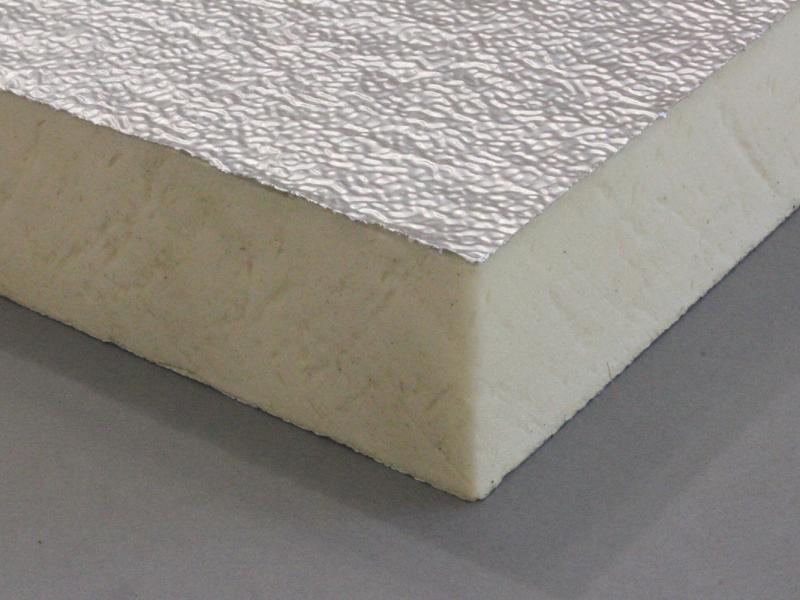
Polyurethane (PU) insulation boards are characterised by their extremely low thermal conductivity, with a nominal value from 0.022 W/(m²K). This makes them particularly space-saving, as only thin layers are required to achieve a high level of insulation. Due to their closed-cell structure, polyurethane panels possess good thermal insulation properties. This structure also ensures that no moisture is absorbed. The vapour diffusion behaviour depends on the panel’s facing. Panels with an aluminium facing achieve the lowest thermal conductivity. Other types of facing result in slightly higher thermal conductivity.
Owing to their high compressive strength, moisture resistance and resistance to mould and rot, polyurethane panels are used, amongst other things, for roof, floor and façade insulation. As composite elements, PU boards allow the insulated area to be walked on immediately, for example in floor insulation.
As polyurethane belongs to the thermoset family, PU insulation materials do not melt and retain their shape even at high temperatures. PU insulation materials are classified as normally flammable (fire class E or D in accordance with DIN EN 13501-1) or flame-retardant (fire class C in accordance with DIN EN 13501-1). There is no risk of smouldering fires with PU insulation materials.
Rohstoffe und Herstellungsverfahren
Raw materials: polyols, polyisocyanate, pentane blowing agent, flame retardants (halogenated phosphoric acid esters: TCPP and TEP), and, where applicable, aluminium, polyester, glass, mineral fibre and paper laminates
First, the blowing agent is mixed with the polyols, after which the polyisocyanate is added. This triggers a polyaddition reaction, which leads to the formation of polyurethane. Heat is released during the reaction, the blowing agent evaporates and the material is foamed. The polyaddition reaction produces both polyurethane (PUR) and polyisocyanurate (PIR) structures. Depending on the formulation and manufacturing process, either PUR or PIR structures predominate in the finished product. The umbrella term ‘PU’ encompasses the product variants PUR and PIR. In the so-called double-belt process, the reaction mixture is applied to the lower laminate and bonds with the upper laminate as it foams. Foam blocks can be produced in a continuous process and cut to length, or foamed in individual moulds.
|
Technical Specifications
Property | Unit | Parameters | ||
|---|---|---|---|---|
| Thermal conductivity λR | W/(mK) | 0.022 | 0.023 – 0.027 | 0.025 – 0.028 |
| Bulk density ρ | kg/m³ | 31–32 | 33.6 | 31–32 |
| Heat capacity c | J/(kgK) | 1200–1500 | 1200–1500 | 1200–1500 |
| Fire class in accordance with EN 13501-1 | -- | E - C | E - C | E – C |
| Water vapour diffusion resistance μ | -- | diffusion-tight | 40–200 | 40–200 |
| Primary energy content (A1–A3) | kWh/m³ | 871 | 761 | 769 |
| Water-repellent effect | -- | yes | yes | yes |
| Pressure-resistant | -- | yes | yes | yes |
*Comparative U-value: 1.0 W/(m²K)
Pure polyurethane panels can be reused either in manufacturing or as raw materials. Recycled polyurethane building products are available on the market, in the form of sheet-shaped functional materials or blow-in insulation made from recycled polyurethane granules. If recycling is not possible, polyurethane panels are sent for thermal recovery
The building regulations approvals were withdrawn in accordance with EU law
Gesundheit und Ökologie
Nowadays, only the blowing agent pentane is used in the manufacture of PU insulation boards. Due to the closed-cell structure of the foam, this hydrocarbon remains in the insulation material over the long term. The isocyanates used in production are completely consumed during the manufacture of the PU panels and are no longer present in monomeric form in the end product. Consequently, there is no outgassing of isocyanates from the product. [vi]. The manufacture of PU insulation materials takes place in a factory setting as part of a closed industrial process. Occupational health and safety and environmental protection measures ensure that employees and the environment are not put at risk by hazardous substances during production. For products bearing the Pure Life label, emissions are regularly checked and assessed on a random basis by independent institutes. PU products are considered to be low-emission.
|
[i] Environmental Product Declaration EPD-IVP-20220220-IBE1-DE (2022); ‘PU insulation boards made from block foam’; Institut Bauen und Umwelt e.V., Berlin [ii] Environmental Product Declaration EPD-IVP-20240422-IBE1-DE (2024); ‘PU insulation boards with a 50 μm aluminium facing’; Institut Bauen und Umwelt e.V., Berlin [iii] Environmental Product Declaration EPD-IVP-20240424-IBE1-DE (2024); ‘PU insulation boards with multi-layer aluminium facing’; Institut Bauen und Umwelt e.V., Berlin [iv] Environmental Product Declaration EPD-IVP-20240423-IBE1-DE (2024); “PU insulation boards with a mineral fleece facing layer”; Institut Bauen und Umwelt e.V., Berlin [v] https://www.wecobis.de/bauproduktgruppen/daemmstoffe-pg/daemmstoffe-synthetisch-pg/polyurethan-hartschaum.html (accessed on 19 January 2025)
|
- high specific insulation performance
- wide range of applications
- High pressure resistance
- high primary energy content during manufacture
- fossil raw materials