Glass wool panels
Insulation boards
Plaatisolatiematerialen
Plattendämmstoffe
Mats for thermal insulation
Mattenisolatiematerialen
Mattendämmstoffe
Loose-fill and blow-in insulation materials
Stort- en inblaasisolatiematerialen
Schütt- und Einblasdämmstoffe
Speciality products
Speciale producten
Spezialprodukte
Eigenschaften
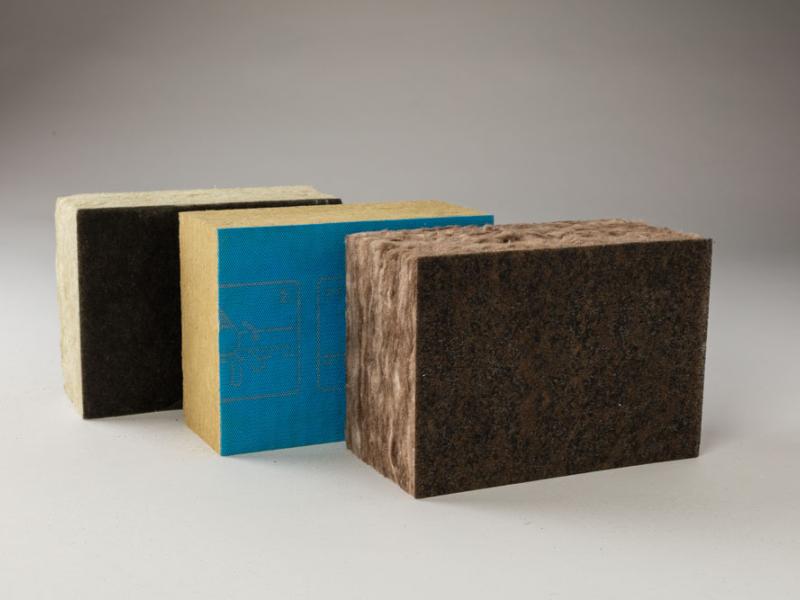
Like all mineral wool insulation products, glass wool boards are non-combustible and have an open-cell structure. In addition to their excellent thermal insulation properties, due to their low thermal conductivity of 0.031 W/mK (design value) and above, glass wool insulation boards also make a significant contribution to sound insulation in buildings.
The boards are suitable for use in both new-builds and renovation projects and can be installed in various areas such as roofs, walls and floors. Glass wool insulation boards are used in particular in drywall construction, for core insulation, façade insulation and as impact sound insulation within buildings.
Rohstoffe und Herstellungsverfahren
Raw materials: up to 80 per cent recycled glass, dolomite, quartz sand, soda, limestone, small quantities of binders and water-repellent agents, as well as recycled production residues
Glass wool boards are manufactured in the same way as glass wool mats, by first melting the raw materials at approximately 1400 °C. The melt is then defibrated using the so-called spin-blowing process, similar to the production of candy floss. In this process, a thin stream of glass strikes a rapidly rotating metal basket, where it is ejected through thousands of tiny holes. This creates strands which are drawn out into fibres using a gas burner and compressed air.
This is followed by the addition of small quantities of binding agents and water-repellent agents, and a further heating stage. This causes the binding agent – which today is usually composed of renewable raw materials – to set. In the final step, the glass wool slabs are cut to size and prepared for onward transport.
Glass wool insulation materials are recyclable. To be melted down, they must be sorted by type and free from foreign matter (e.g. plaster). Ground-up mineral wool can also be used as an additive in the manufacture of bricks, fibre-cement sheets and roof tiles.[i] Otherwise, it is disposed of in landfill.
Thanks to the take-back and recycling schemes offered by mineral wool manufacturers, several thousand tonnes of mineral wool from construction sites and demolition projects can already be recycled into new mineral wool every year. Recycling capacities are being continuously expanded.
DIN EN 13162 in conjunction with DIN 4108-10, Table 3 (Application-specific requirements for mineral wool thermal insulation materials)
Gesundheit und Ökologie
In Germany, only mineral wool products – namely rock wool and glass wool – that pose no risk to health and are approved in accordance with the Hazardous Substances Ordinance (GefStoffV) and the Chemicals Prohibition Ordinance (ChemVerbotsV) may be placed on the market and installed. These products bear the RAL quality mark ‘Mineral Wool Products’, which is awarded by the Gütegemeinschaft Mineralwolle e.V. [ii] The Gütegemeinschaft monitors and checks compliance with the certification requirements. The KEYMARK quality mark also certifies the high quality of mineral wool insulation materials.
An environmental benefit of manufacturing glass wool boards is the use of recycled glass and production residues, as well as their good compressibility, which results in reduced packaging and transport requirements. Production processes are also continuously improved to conserve resources. As glass wool is a regional product, transport distances are also short.
[i] ENVIRONMENTAL PRODUCT DECLARATION in accordance with ISO 14025 and EN 15804+A2: Mineral wool insulation in the low bulk density range, FMI Fachverband Mineralwolleindustrie e.V., 29 June 2023: https://www.der-daemmstoff.de/wp-content/uploads/2023/07/Mineralwolle-Daemmstoff-im-niedrigen-Rohdichtebereich_EN15804A2.pdf (accessed on 11 December 2025)
[ii] Gütegemeinschaft Mineralwolle e.V.: https://www.ral-mineralwolle.de (accessed on 3 July 2024)
- very low thermal conductivity
- good value for money
- extensive experience with the insulation material; readily available
- Recycled glass as the main raw material
- Compressibility (reduced packaging and transport costs)
- Short transport distances
- Non-combustible (A1)
- Good sound insulation
- Recyclable or reusable (clean, single-type glass wool)
- Energy consumption during production must be reduced further
- Applications with no compressive strength requirements