Jute mats
Insulation boards
Plaatisolatiematerialen
Plattendämmstoffe
Mats for thermal insulation
Mattenisolatiematerialen
Mattendämmstoffe
Loose-fill and blow-in insulation materials
Stort- en inblaasisolatiematerialen
Schütt- und Einblasdämmstoffe
Speciality products
Speciale producten
Spezialprodukte
Eigenschaften
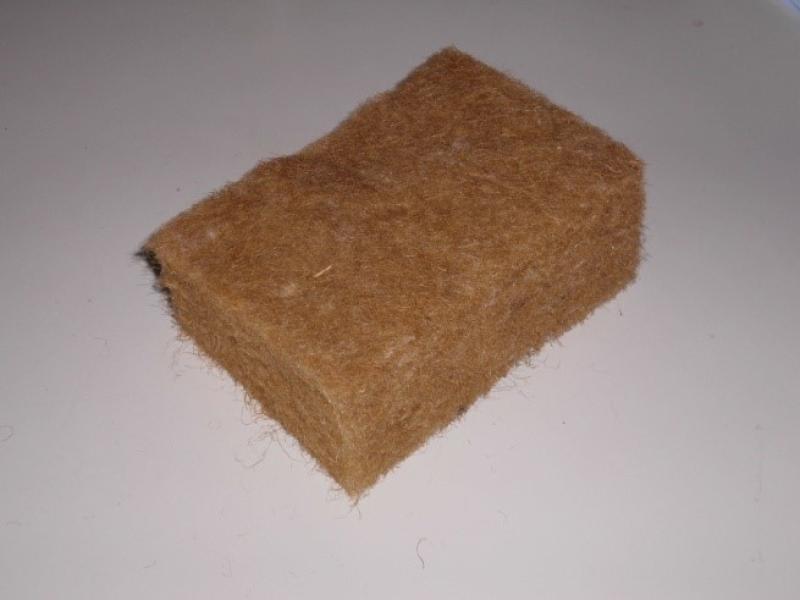
In addition to their thermal insulation properties, jute mats offer high levels of heat protection in summer and sound insulation. They also have a high sorption capacity, which helps to regulate the moisture balance.
Owing to these properties, they are particularly suitable for roof insulation, such as between-rafter insulation, on-rafter insulation between auxiliary rafters, under-rafter insulation and internal insulation in general. They are used to insulate timber-beamed ceilings as well as external and internal walls in timber-frame and timber-stud construction. Other applications include the insulation of metal-stud walls and cladding systems.
Rohstoffe und Herstellungsverfahren
First, old jute sacks are processed into high-quality fibres. The jute fibres are then treated with the fire retardant soda and stored. The mats are only produced to order. During this process, the fibres are combined with Biko fibres and heated to form a mat-like insulating material. Composition: 82–86% jute, 11–13% Biko fibres, PEG as a binder, 3–5% soda as a fire retardant. Manufacturer’s
availability:
The material is not available on the German market.
Technical Specifications
| Property | Unit | Parameters |
| Thermal conductivity λB | W/(mK) | 0.039* |
| Bulk density ρ | kg/m³ | 34–40 |
| Heat capacity c | J/(kgK) | 2350 |
| Building material class (DIN EN 13501-1) | -- | E |
| Water vapour diffusion resistance μ | -- | 1–2 |
| Primary energy content | kWh/m³ | N/A |
| Water-repellent effect | -- | no |
When the structure is dismantled, the jute fibres can be recycled. If they cannot be reused, the remaining material can be incinerated.
ETA-20/0606
Gesundheit und Ökologie
The jute mats are a recycled product made from jute fibres extracted from old cocoa transport sacks. As a result, the insulation material requires very little primary energy to produce. The product is harmless from both a health and environmental perspective.
- partly recyclable
- sound-insulating
- summer heat protection
- moisture-regulating
- easy to work with
- some of which contain bioplastic fibres
- relatively expensive