Glass wool mats WLS 032 – 035
Insulation boards
Plaatisolatiematerialen
Plattendämmstoffe
Mats for thermal insulation
Mattenisolatiematerialen
Mattendämmstoffe
Loose-fill and blow-in insulation materials
Stort- en inblaasisolatiematerialen
Schütt- und Einblasdämmstoffe
Speciality products
Speciale producten
Spezialprodukte
Eigenschaften
Just like other mineral wool products, glass wool mats are characterised by the fact that they are non-combustible, age-resistant, and resistant to weathering and decay. Glass wool mats also offer the following advantages:
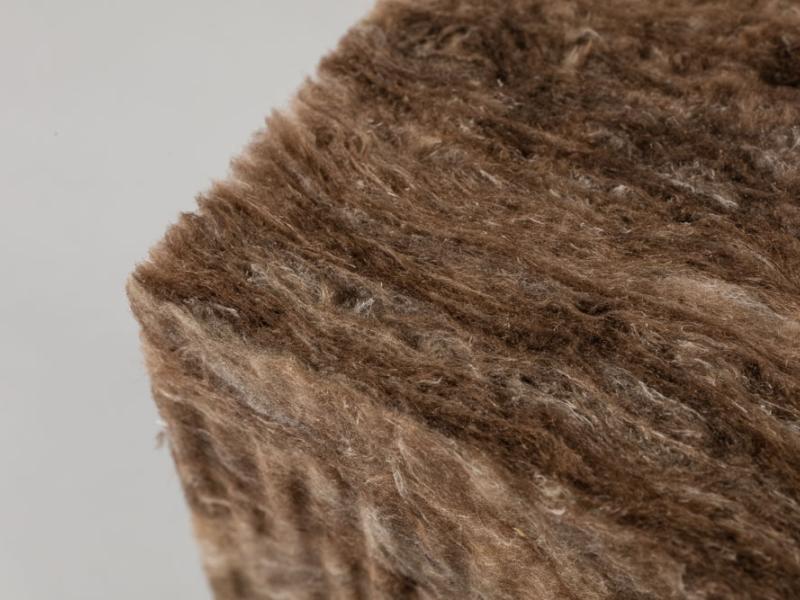
Glass wool mats are already available on the market with a thermal conductivity as low as 0.032 W/mK (rated value). Furthermore, glass wool mats are very flexible; their high compressibility makes them even easier to transport and, for example, simpler to install in between-rafter insulation than insulation boards. Glass wool mats are therefore particularly suitable for applications where a high degree of flexibility in the insulation material is required (pitched roof insulation as between-rafter and under-rafter insulation, insulation of the top floor ceiling, insulation of partition walls, etc.).
When installing the insulation, as with all indoor work, suitable workwear should be worn to protect against dust generated during the process.
Rohstoffe und Herstellungsverfahren
Raw materials: up to 80 per cent recycled glass, dolomite, quartz sand, soda, limestone, small quantities of binders and water-repellent agents, as well as recycled production residues
Glass wool mats are manufactured in a similar way to glass wool boards: the raw materials are melted at approximately 1,400 °C and the melt is then defibrated using a spin-blowing process – similar to the production of candy floss. In this process, a thin stream of glass strikes a rapidly rotating metal basket and is ejected through thousands of tiny holes. This produces strands which are drawn out into fibres using a gas burner and compressed air.
An aqueous binder solution is then sprayed onto the fibres and allowed to set. These binders are now mostly produced from renewable raw materials. Finally, the glass wool mats are cut to the required size and shape and packed for onward transport.
Technical Specifications
Property | Unit | Parameters | ||
|---|---|---|---|---|
| Thermal conductivity λR | W/(mK) | 0.032 | 0.035 | 0.040 |
| Bulk density ρ | kg/m³ | 25–35 | 15–25 | 10–15 |
| Heat capacity c | J/(kgK) | 840 | 840 | 840 |
| Building material class | -- | A1 | A1 | A1 |
| Water vapour diffusion resistance μ | -- | 1 | 1 | 1 |
| Primary energy content | kWh/m³ | 100–800 | 100–800 | 100–800 |
| Water-repellent effect | -- | yes | yes | yes |
Glass wool insulation materials are recyclable. To be melted down, they must be sorted by type and free from foreign materials (e.g. plaster). Ground mineral wool can also be used as an additive in the manufacture of bricks, fibre-cement boards and roof tiles.[i] Otherwise, it is disposed of in landfill.
Mineral wool manufacturers offer take-back and recycling schemes, through which several thousand tonnes of mineral wool are already being recycled each year from construction sites and demolition projects to produce new mineral wool. Recycling capacities are being continuously expanded.
DIN EN 13162 in conjunction with DIN 4108-10, Table 3 (Application-specific requirements for mineral wool thermal insulation materials)
Gesundheit und Ökologie
In Germany, only mineral wool products – namely rock wool and glass wool – that pose no health risks and are approved in accordance with the Hazardous Substances Ordinance (GefStoffV) and the Chemicals Prohibition Ordinance (ChemVerbotsV) may be placed on the market and installed. These products bear the RAL quality mark ‘Mineral Wool Products’, which is awarded by the Gütegemeinschaft Mineralwolle e.V.[ii] The Gütegemeinschaft monitors and checks compliance with the certification requirements. The KEYMARK quality mark also certifies the high quality of mineral wool insulation materials.
From an environmental perspective, the use of recycled glass, the good compressibility and, consequently, the reduced packaging and transport requirements are positive factors. Furthermore, manufacturers are already operating on a waste-free basis and working to reduce CO₂ emissions in the production process.
[i] ENVIRONMENTAL PRODUCT DECLARATION in accordance with ISO 14025 and EN 15804+A2 for mineral wool insulation materials in the low bulk density range, FMI Fachverband Mineralwolleindustrie e.V., 29 June 2023: https://www.der-daemmstoff.de/wp-content/uploads/2023/07/Mineralwolle-Daemmstoff-im-niedrigen-Rohdichtebereich_EN15804A2.pdf (accessed on 11 December 2025)
[ii] Gütegemeinschaft Mineralwolle e.V.: https://www.ral-mineralwolle.de (accessed on 3 July 2024)
- very low thermal conductivity
- very good value for money
- Extensive experience with this insulation material; readily available
- Recycled glass as the main raw material
- short transport distances
- Highly compressible (reduced packaging and transport costs)
- non-combustible (A1)
- Good sound insulation
- Recyclable or reusable (single-type, clean glass wool)
- Energy consumption during manufacture must be reduced further
- only for applications with no compressive strength requirements