WLS 033 blown-in EPS insulation
Insulation boards
Plaatisolatiematerialen
Plattendämmstoffe
Mats for thermal insulation
Mattenisolatiematerialen
Mattendämmstoffe
Loose-fill and blow-in insulation materials
Stort- en inblaasisolatiematerialen
Schütt- und Einblasdämmstoffe
Speciality products
Speciale producten
Spezialprodukte
Eigenschaften
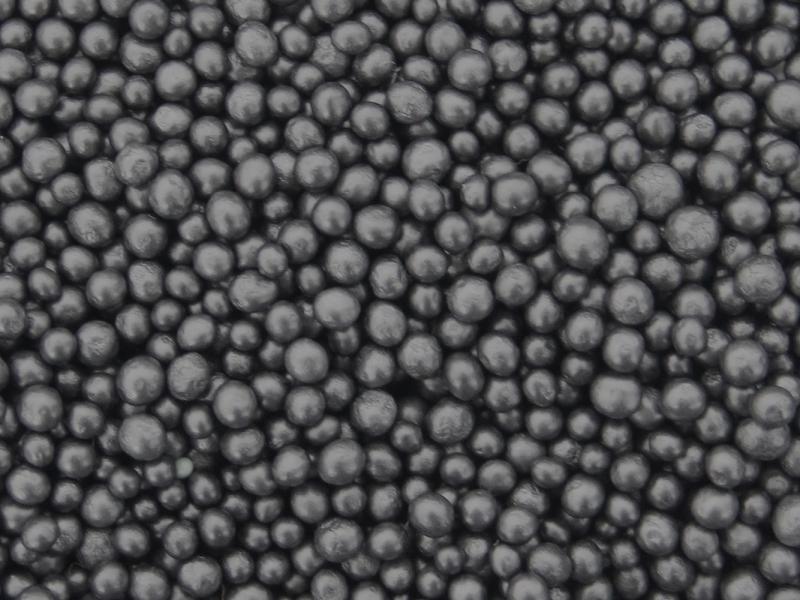
Due to its water-repellent properties, expanded
polystyrene granules are used for backfilling double-skin masonry using mechanical methods, in accordance with building regulations.
The material is dimensionally stable and resistant to rot and ageing
Thanks to its fine grain size, the granules flow and run freely, enabling them to reach every joint. Only a few small drill holes per storey are required to introduce the material into the wall structure.
Due to the material’s excellent flowability, appropriate precautions should be taken in advance by certified installers to prevent any spillage.
Rohstoffe und Herstellungsverfahren
Raw materials: Styrene (from the pyrolysis products of crude oil). Blowing agent (pentane), flame retardant Polymer-FR (brominated styrene-butadiene copolymer), graphite
The manufacturing process consists of two stages: first, the styrene monomer (derived from petroleum pyrolysis products) is polymerised to form polystyrene. The EPS granules are expanded using the blowing agent pentane at temperatures of approx. 100°C with the addition of steam. After temporary storage, these foam particles are processed into blocks, sheets and moulded parts via a second hot-steam treatment. In the production of blow-in insulation, these final steps are omitted; the expanded polystyrene beads are used without further treatment.
Technical Specifications
Property | Unit | Parameters |
|---|---|---|
| Design value λB | W/(mK) | 0.033–0.035 |
| Bulk density ρ | kg/m³ | 16–26 |
| Heat capacity c | J/(kgK) | 1300 |
| Building material class (DIN 4102-1) | -- | B2 |
| Water vapour diffusion resistance μ | -- | 5 |
| Primary energy content | kWh/m³ | N/A |
| Water-repellent effect | -- | yes |
*Comparative U-value: 1.0 W/(m²K)
The insulation material is 100 per cent recyclable.
Z-23.12-1632
Legal provisions: §§:
Blown-in insulation is only considered insulation within the meaning of building regulations if it has been installed by specialist contractors who have been trained in its use by the relevant manufacturer and are included on a list. If installed by a DIY enthusiast themselves, the material will provide insulation but is not legally considered insulation material. In the event of damage (e.g. fire), this could lead to problems with insurance companies. Furthermore, any subsidies are forfeited for structures in which self-installed blow-in insulation has been used. Even in the case of ‘KfW-x’ buildings or new builds, these insulation materials must not be included in the calculations carried out by energy consultants or architects.
Gesundheit und Ökologie
When considering the entire life cycle of EPS – from production right through to recycling following building demolition – EPS offers clear advantages. In this holistic assessment, EPS was examined from manufacture through to recycling. EPS ranks among the top performers in terms of environmental performance.
The removal of EPS insulation requires no special protective measures. The new flame retardant, Polymer FR, which has been in use since the end of 2014, was developed exclusively for use in polystyrene foam products.
EPS offers many viable recycling options, including mechanical recycling, thermal recovery and physical recycling. This applies both to newly manufactured products and to end-of-life EPS containing the former flame retardant HBCD. EPS thus meets the increasingly stringent requirements for recyclability.
- many years’ experience
- good availability
- water-repellent (suitable for core insulation)
- Good value for money
- Due to its high flowability, the product is particularly suitable for partially insulated walls that already contain mat or board insulation materials
- The product may trickle out through openings in the cavity (e.g. in roller shutter boxes). These must be sealed without leaving any gaps against the cavity wall before the insulation is installed
- The external walls are very often open at the top near the wall coping. Appropriate measures (sealing the cavity at the top with packing or mat-type insulation materials) must be taken to ensure that the core insulation is not sucked out of the top during strong winds. This measure is an essential part of the scope of services provided by a core insulation contractor.