Blown-in rock wool insulation WLS 035 – 038
Insulation boards
Plaatisolatiematerialen
Plattendämmstoffe
Mats for thermal insulation
Mattenisolatiematerialen
Mattendämmstoffe
Loose-fill and blow-in insulation materials
Stort- en inblaasisolatiematerialen
Schütt- und Einblasdämmstoffe
Speciality products
Speciale producten
Spezialprodukte
Eigenschaften
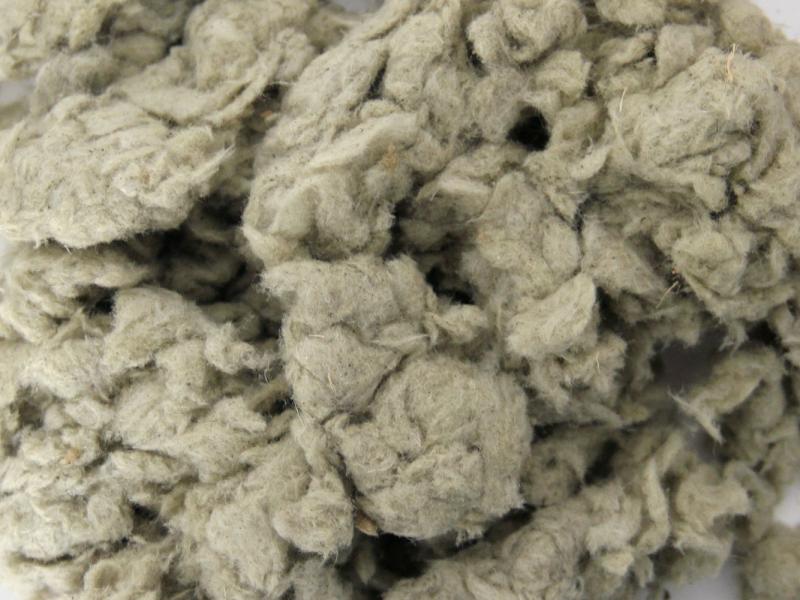
Rock wool is a non-combustible building material that is available not only in the form of, for example, boards and mats, but also as blow-in insulation. Like all mineral wool products, blow-in rock wool insulation has both thermal and sound-insulating properties. As a fibrous product, it does not settle and is suitable for insulating timber-beamed ceilings, sloping roofs, rafters, external walls, building partition walls and for internal insulation.
A water-repellent rock wool blow-in insulation is used for core insulation. Furthermore, rock wool blow-in insulation is used to backfill service ducts. This ensures the necessary fire protection, particularly in multi-storey residential buildings.
Rohstoffe und Herstellungsverfahren
Raw materials for rock wool: diabase, basalt, dolomite, phonolite and recycled rock wool, small quantities of binding agents and, where necessary, water-repellent agents, as well as other (secondary) raw materials and recycled production residues
The feedstock, comprising mineral raw materials and recycled rock wool, is melted in a furnace at approximately 1,500 °C and then spun into fibres using a centrifugal or jet-blowing process. The spinning process resembles the natural activity of a volcano: when a lava fountain forms during a volcanic eruption, winds pull thin strands from the lava: natural mineral wool – known in Hawaii as ‘Pele’s hair’.
In the centrifugal process, a jet of the still-molten mass strikes rapidly rotating flywheels and is spun into fibres by the rotational movement. In the nozzle-blowing process, the liquid glass melt flows through a large number of nozzles after passing through the melting tank. The strands produced in this way are drawn out into fibres by compressed air. Blown-in rock wool insulation materials are usually produced by shredding production waste.
Technical Specifications
Property | Unit | Parameters | ||
|---|---|---|---|---|
| Core insulation | Timber panel construction | Top floor slab | ||
| Thermal conductivity λR | W/(mK) | 0.035 | 0.035 | 0.038 |
| Bulk density ρ | kg/m³ | 65–120 | 65–100 | 45–100 |
| Heat capacity c | J/(kgK) | 840 | 840 | 840 |
| Building material class | -- | A1 | A1 | A1 |
| Water vapour diffusion resistance μ | -- | 1 | 1 | 1 |
| Primary energy content | kWh/m³ | 270 | 270 | 270 |
| Water-repellent effect | -- | yes | N/A | N/A |
Rock wool insulation materials are recyclable. Provided the insulation is sorted by type and free from foreign materials (e.g. plaster), it can be recycled by remelting and may even be reused. The product can be extracted by type and installed in new cavity spaces. Furthermore, rock wool offcuts can be processed, for example, in the brick industry and for the production of fibre-cement sheets and roof tiles.[i] Otherwise, it is disposed of in landfill.
In recent years, mineral wool manufacturers have developed take-back and recycling systems, thanks to which many thousands of tonnes of mineral wool from construction sites and demolition projects are now recycled into new mineral wool every year. Recycling capacities are being continuously expanded.
EN 14064-1 and EAD040729-00-1201 in conjunction with DIN 4108-10, Table 16 (Application-specific requirements for blown-in mineral wool insulation materials)
Legal provisions:
A blow-in insulation material is only considered an insulation material within the meaning of building regulations if it has been installed by specialist contractors who have been trained in its handling by the relevant manufacturer and are included on a list. If installed by a DIY enthusiast themselves, the material is insulating but, from a legal perspective, does not constitute insulation. In the event of damage (e.g. fire), there could be problems with insurance companies. Furthermore, any subsidies are not available for structures in which self-installed blow-in insulation has been used. Even in the case of ‘KfW-x’ buildings or new builds, these insulation materials must not be included in the calculations carried out by energy consultants or architects.
Gesundheit und Ökologie
In Germany, only mineral wool products – namely rock wool and glass wool – that pose no risk to health and are approved in accordance with the Hazardous Substances Ordinance (GefStoffV) and the Chemicals Prohibition Ordinance (ChemVerbotsV) may be placed on the market and installed. These products bear the RAL quality mark ‘Mineral Wool Products’, which is awarded by the Gütegemeinschaft Mineralwolle e.V.[ii] The Gütegemeinschaft monitors and checks compliance with the certification requirements. The KEYMARK quality mark further certifies the high quality of mineral wool insulation materials.
From an environmental perspective, the relatively short transport distances and the good availability of raw materials are to be regarded as advantages. Furthermore, these are recycled products. The long service life of rock wool insulation materials is also a positive factor. Furthermore, manufacturers are already operating waste-free and are developing solutions to further reduce CO₂ emissions during production.
[i] ENVIRONMENTAL PRODUCT DECLARATION in accordance with ISO 14025 and EN 15804+A2: Mineral wool insulation in the low bulk density range, FMI Fachverband Mineralwolleindustrie e.V., 29 June 2023: https://www.der-daemmstoff.de/wp-content/uploads/2023/07/Mineralwolle-Daemmstoff-im-niedrigen-Rohdichtebereich_EN15804A2.pdf (accessed on 11 December 2025)
[ii] Gütegemeinschaft Mineralwolle e.V.: https://www.ral-mineralwolle.de (accessed on 3 July 2024)
- Good availability of raw materials, short transport distances
- Extensive experience with the insulation material, readily available
- Long service life
- suitable for core insulation
- No sifting
- non-combustible (A1)
- Good sound insulation
- recyclable
- In the case of double-shell masonry, a minimum distance of 4 cm between the masonry shells is required
- where necessary, more and larger drill holes for blowing insulation into the double-shell masonry