Phenolic resin sheets WLS 020-023
Insulation boards
Plaatisolatiematerialen
Plattendämmstoffe
Mats for thermal insulation
Mattenisolatiematerialen
Mattendämmstoffe
Loose-fill and blow-in insulation materials
Stort- en inblaasisolatiematerialen
Schütt- und Einblasdämmstoffe
Speciality products
Speciale producten
Spezialprodukte
Eigenschaften
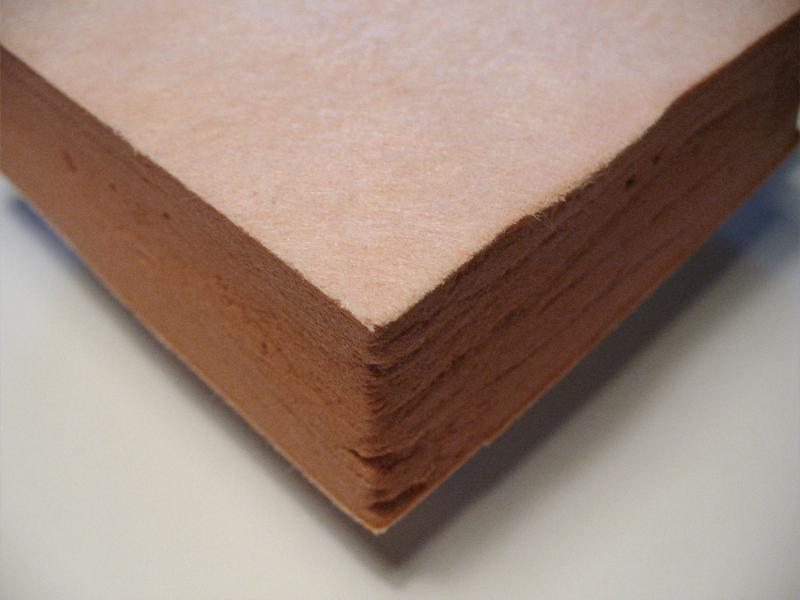
The phenolic resin board is characterised by a low specific thermal conductivity of up to 0.021 W/(mK). A U-value of 0.14 W/(m²K) for external walls can be achieved in existing buildings with insulation thicknesses of 14 cm, whilst other insulation materials require thicknesses of up to 22 cm to achieve the same result. Due to their low thermal conductivity, phenolic resin boards are particularly suitable for applications where space-saving insulation is required. Areas of application include: roller shutter boxes, soffit insulation, external wall insulation or under-rafter insulation requiring low thickness but high thermal performance.
Phenolic resin boards are weather-resistant and therefore suitable for external wall insulation systems (ETICS). Furthermore, the insulation material can withstand mechanical loads, making it possible to install the insulation beneath floating screeds. Other areas of application include above- and under-rafter insulation, internal insulation of external walls and core insulation.
Rohstoffe und Herstellungsverfahren
Raw materials: phenol, formaldehyde, lamination (glass fibre, aluminium composite films)
The two components, phenol and formaldehyde, are heated together with a catalyst, whereby the polymeric phenolic resin is formed through condensation. In the next step, the phenolic resin is mixed with the blowing agent pentane and then foamed. The foam is laminated and cured.
Technical Specifications
Property | Unit | Parameters |
|---|---|---|
| Thermal conductivity λ*) | W/(mK) | 0.021–0.025 |
| Bulk density ρ | kg/m³ | 35–40 |
| Heat capacity c | J/(kg·K) | 1500–1800 |
| Building material class | -- | B1, B2 |
| Water vapour diffusion resistance μ | -- | 10–50 |
| Primary energy content (A1–A3) | kWh/m³ | 706.4 |
| Water-repellent effect | -- | no |
| Pressure-resistant | -- | yes |
*) Rated value
No information is available regarding the disposal of the insulation material. However, as a general rule, formaldehyde resins can either be recycled through thermal recovery or disposed of in landfill following prior thermal pre-treatment.
DIN EN 13166; Z-33.43-1182, P-SAC 02/III-041
Gesundheit und Ökologie
The raw materials, phenol and formaldehyde, are derived from fossil fuels (natural gas, coal, crude oil). However, only small quantities are required due to the foaming process. No data is available on the energy consumption involved in production. From a health perspective, it should be noted that whilst the raw materials are toxic, this toxicity is eliminated during the condensation process. There is no information on whether any free monomers remain in the matrix and are released into the environment over the long term. In the event of a fire, the monomers are released again; however, in principle, the combustion of all materials produces toxic substances, including formaldehyde.
- high specific insulation performance
- space-saving
- easy to work with
- the most cost-effective high-performance insulation material
- can be plastered over, making it suitable for external thermal insulation composite systems (ETICS)
- In some cases, a lack of information on risks and disposal
- based on fossil raw materials