XPS boards WLS 033 – 040
Insulation boards
Plaatisolatiematerialen
Plattendämmstoffe
Mats for thermal insulation
Mattenisolatiematerialen
Mattendämmstoffe
Loose-fill and blow-in insulation materials
Stort- en inblaasisolatiematerialen
Schütt- und Einblasdämmstoffe
Speciality products
Speciale producten
Spezialprodukte
Eigenschaften
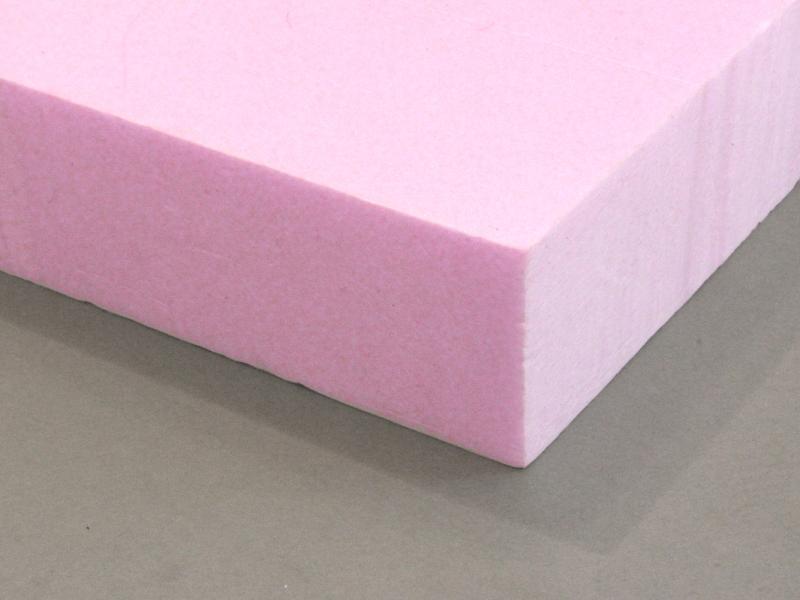
XPS boards are extremely versatile. They are used for both internal and external insulation of walls, roofs and floors. Their key properties include very high compressive strength, resistance to rot, low water absorption and low weight. This means that even structural elements where many other insulation materials cannot be used can be insulated, for example, elements in contact with the ground (perimeter insulation) and inverted roofs. External thermal insulation composite system (ETICS) insulation is also possible with XPS boards.
Insulation installed between rafters can be problematic, as the insulation material cannot compensate for the shrinkage of the timber. For use in timber structures, treatment with a chemical wood preservative is required.
Recommendations for the use of XPS
Types of application in accordance with DIN 4108-10:
- PB: Perimeter insulation in the presence of ground moisture. Installation of insulation boards in the presence of ground moisture and non-stagnant seepage water.
- PW: Perimeter insulation where water is under pressure. Installation in one to three layers where there is prolonged standing water or water under pressure.
- DEO: Thermal insulation for residential floor areas. Insulation of residential floor areas.
- DEO: Industrial and cold store floors. Suitable for use in industrial and cold store floors due to high compressive strength.
- WI: Internal insulation. Suitable for use as internal insulation to reduce heat loss.
- WAP: Plinth insulation. Insulation in the plinth area to prevent thermal bridges.
- DUK: Roof and terrace insulation. Suitable for use in inverted roofs, plus roofs and terrace roofs.
- Green roof insulation: Suitable for use in green roofs in accordance with the relevant type approvals.
Rohstoffe und Herstellungsverfahren
Raw materials: styrene (from the pyrolysis products of crude oil), blowing agents (carbon dioxide, halogen-free co-blowing agents), flame retardant Polymer-FR
The production of XPS boards involves two stages. First, the styrene monomer is polymerised to form polystyrene. In the next stage, the polystyrene granules are melted and the blowing agent is added. The melt is extruded through a wide-slot die. The resulting foam strands are cooled and cut into boards.
Technical Specifications
Property | Unit | Parameters | ||
|---|---|---|---|---|
| Thermal conductivity λR | W/(mK) | 0.033–0.034 | 0.035 | 0.036–0.040 |
| Bulk density ρ | kg/m³ | 20–60 | 20–60 | 20–60 |
| Heat capacity c | J/(kgK) | 1400–1500 | 1400–1500 | 1400–1500 |
| Building material class | -- | B1, B2 | B1, B2 | B1, B2 |
| Water vapour diffusion resistance μ | -- | 80–300 | 80–300 | 80–300 |
| Primary energy content | kWh/m³ | 870 | 870 | 870 |
| Water-repellent effect | -- | yes | yes | Yes |
| Can it withstand pressure? | -- | yes | Yes | Yes |
*Comparative U-value: 1.0 W/(m²K)
Production offcuts and scrap material can, for example, be used to produce XPS granules. Used insulation boards can be reused, depending on their condition, or sent for thermal recovery. Alternatively, they can be disposed of at a construction waste tip.
DIN EN 13164; Z-23.34-1760, Z-23.34-1493, Z-23.15-1416
Gesundheit und Ökologie
Extruded polystyrene sheets contain two potentially toxic substances. Styrene is used as the starting material. This is considered to be carcinogenic and neurotoxic[i]. As the polymerisation product, polystyrene, is regarded as safe, styrene is primarily a problem during the manufacture of the sheets, when emissions occur[ii]. Higher emissions can also occur during incineration[iii]. The second critical substance is hexabromocyclododecane, which is used as a flame retardant. HBCD has been classified as a substance of very high concern under the European REACH chemicals regulation[iv]. However, it is embedded within the polymer matrix. From 2016 onwards, the flame retardant Polymer-FR has been used, which has been officially classified as safe by the Federal Environment Agency.
Even in interior applications, XPS does not come into contact with indoor air. There are no known health risks associated with the use of XPS for internal insulation.
When assessing its environmental impact, it should also be noted that the raw material is petroleum, a fossil fuel. However, the quantities required are fairly small due to the high volume of trapped air in the insulation material. Another negative aspect is the relatively high energy consumption.
Most manufacturers of XPS boards are members of the Fachvereinigung Extruderschaum (Extruded Foam Trade Association).
Sustainability
CO₂ savings and payback
Over its life cycle, XPS can save up to 600 times as much CO₂ as is released during its manufacture. The CO₂ footprint of XPS is fully offset just one year after installation. This means that the amount of CO₂ released during production is offset within a year by the energy savings achieved.
Lifespan
XPS is renowned for its durability. When installed correctly, XPS lasts for the entire service life of the building, leading to long-term energy savings and making it extremely sustainable.
Recycling
XPS is fully recyclable. The Professional Association for Extruded Foam (FPX e.V.) has established a comprehensive recycling system in Germany.
http://www.bfr.bund.de; Press release 25/2006
www.wecobis.de (accessed on 20 August 2012)
Ortner, Hensler; ‘Assessment of plastic fires – Substances arising from a disruption to normal operation in accordance with Annexes II–IV of the 12th BImSchV’; Ref: 1/7-1515-21294; 7 November 1995
Environmental Product Declaration EPD-FPX-2010111-D; Institut Bauen und Umwelt e.V.; 7 July 2010
- a wide range of applications
- extensive experience
- low thermal conductivity
- Specialised applications (ETICS, perimeter and inverted roof insulation)
- the only approved insulation material for inverted roof constructions
- relatively high primary energy content
- fossil raw material
- (until 2016) critical flame retardant (HBCD)
- As a rigid board insulation, it cannot be used as between-rafter insulation in roofs or in timber-frame construction.