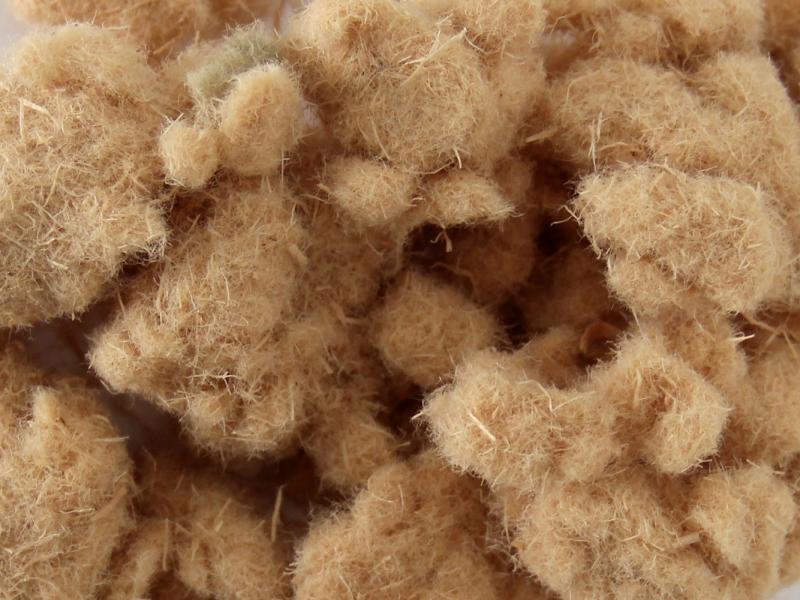
WLS 040 wood fibre blow-in insulation
Insulation boards
Plaatisolatiematerialen
Plattendämmstoffe
Mats for thermal insulation
Mattenisolatiematerialen
Mattendämmstoffe
Loose-fill and blow-in insulation materials
Stort- en inblaasisolatiematerialen
Schütt- und Einblasdämmstoffe
Speciality products
Speciale producten
Spezialprodukte
Eigenschaften
Wood fibre insulation is used for thermal and acoustic insulation, to protect against summer heat, and also has moisture-regulating properties. Thanks to the interlocking structure of the wood fibres, the insulation is resistant to settling. It is installed as blow-in or blow-up insulation and is therefore used, amongst other things, to insulate upper floor slabs, cavities and prefabricated wall and roof elements.
Rohstoffe und Herstellungsverfahren
Raw materials: wood shavings, impregnating agents (ammonium phosphate, borates)
Wood shavings are used as the raw material; these are produced, amongst other things, as production waste during wood processing. For fire protection, the shavings are impregnated with ammonium phosphate and/or borate.
Technical Specifications
Property | Unit | Parameters |
|---|---|---|
| Thermal conductivity λB | W/(mK) | 0.040 |
| Bulk density ρ | kg/m³ | 35–45 |
| Heat capacity c | J/(kgK) | 2100 |
| Fire behaviour DIN EN 13501-1 | -- | E |
| Water vapour diffusion resistance μ | -- | 1–2 |
| Primary energy content | kWh/m³ | 50 |
| Water-repellent effect | -- | no |
*Reference U-value: 1.0 W/(m²K)
The insulation material can be recycled or used for energy recovery.
Legal provisions §§:
Blown-in insulation is only considered insulation within the meaning of building regulations if it has been installed by specialist contractors who have been trained in its use by the relevant manufacturer and are included on a list. If installed by a DIY enthusiast themselves, the material will provide insulation but is not legally classified as insulation. In the event of damage (e.g. fire), this could lead to problems with insurance companies. Furthermore, any subsidies are not available for structures in which self-installed blow-in insulation has been used. Even in the case of ‘KfW-x buildings’ or new builds, these insulation materials must not be included in the calculations carried out by energy consultants or architects.
Gesundheit und Ökologie
The use of impregnating agents can be regarded as probably the only drawback in terms of both health and the environment. In particular, the addition of borates as a fire retardant means that the insulation material is no longer compostable, as this additive is, amongst other things, classified as slightly hazardous to water (WGK 1)[i]. From a health perspective, too, this substance is not entirely harmless; borates have been classified as toxic to reproduction[ii]. However, various insulation manufacturers who use borates play down the toxicity, arguing, on the one hand, that large quantities would need to be ingested or inhaled, and, on the other hand, that the substance is not volatile and, furthermore, that the consumer has no further contact with the product once it has been installed.
[i] Administrative Regulation on Substances Hazardous to Water (VwVwS)
[ii] Directive 2008/58/EC
- Summer heat protection
- affordable
- sound-insulating properties
- good availability of raw materials
- Use of impregnating agents