Straw blow-in insulation WLS 047
Insulation boards
Plaatisolatiematerialen
Plattendämmstoffe
Mats for thermal insulation
Mattenisolatiematerialen
Mattendämmstoffe
Loose-fill and blow-in insulation materials
Stort- en inblaasisolatiematerialen
Schütt- und Einblasdämmstoffe
Speciality products
Speciale producten
Spezialprodukte
Eigenschaften
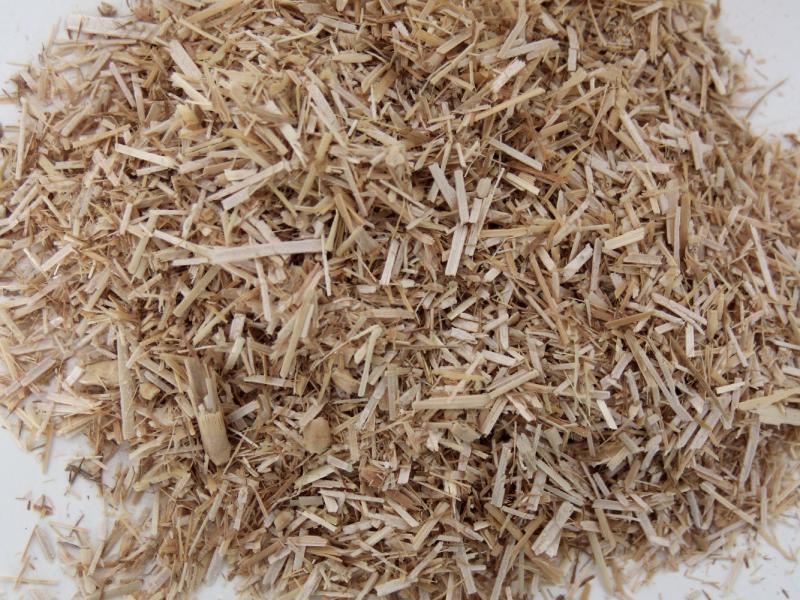
Straw, when used as blow-in insulation, offers not only thermal insulation properties but also excellent sound insulation properties, which are attributable to its higher installation density of 105 kg/m³. Thanks to the natural properties of the raw material, such as its high silicate content, there is no need for additional treatment with fire retardants. Due to its high moisture absorption capacity, the insulation helps to regulate humidity levels in the rooms, thereby improving the indoor climate and providing high levels of heat protection in summer (evaporative cooling). Blown-in straw insulation is suitable for blowing, inflating and pouring, and can be used for walls, ceilings, roofs and partition walls (for sound insulation). For the blow-in method, any standard blow-in machine can be used without the need for an additional blower. Thanks to the regional availability of straw, blow-in insulation can be harvested and processed close to the building site in an increasing number of regions.
Rohstoffe und Herstellungsverfahren
Raw material: wheat straw
The straw is cut, chopped and dust-removed using a patented process to ensure it is suitable for blowing in.
Technical Specifications
| Property | Unit | Parameters |
Thermal conductivity λB (rated value) (Nominal value λD) | W/(mK) | 0.047 0.042 |
| Bulk density ρ | kg/m³ | 85–110 |
| Heat capacity c | J/(kgK) | 2200 |
| Building material class | -- | B2 |
| Water vapour diffusion resistance μ | -- | 3 |
| Primary energy content | kWh/m³ | 5–8 |
| Water-repellent effect | -- | no |
It can be vacuumed up and reused: as bedding for horses and guinea pigs, as fertiliser on fields, or added to strawberry and rose beds.
EAD 0401387-01-1201 ETA - 24/0228
Legal provisions §§:
Blown-in insulation is only considered insulation within the meaning of building regulations if it has been installed by specialist contractors who have been trained in its use by the relevant manufacturer and are included on a list. If installed by a DIY enthusiast themselves, the material may provide insulation but is not legally classified as insulation. In the event of damage (e.g. fire), this could lead to problems with insurance companies. Furthermore, any subsidies are forfeited for structures in which self-installed blow-in insulation has been used. Even in the case of ‘KfW-x’ buildings or new builds, these insulation materials must not be included in the calculations carried out by energy consultants or architects.
Gesundheit und Ökologie
There are no known health concerns. Wheat straw is widely available throughout the region and can easily be processed into blow-in insulation.
- Excellent summer heat protection
- moderate cost structure, recyclable
- Lowest primary energy content of all insulation materials
- High installation density
- Medium thermal conductivity
- Higher costs than, for example, cellulose