EPS panels WLS 032 – 040
Insulation boards
Plaatisolatiematerialen
Plattendämmstoffe
Mats for thermal insulation
Mattenisolatiematerialen
Mattendämmstoffe
Loose-fill and blow-in insulation materials
Stort- en inblaasisolatiematerialen
Schütt- und Einblasdämmstoffe
Speciality products
Speciale producten
Spezialprodukte
Eigenschaften
EPS boards are used for thermal and acoustic insulation. Their applications are extremely varied; the boards are used for both internal and external insulation of walls, ceilings and floors. The traditional application of this insulation material is in external thermal insulation composite systems (ETICS). Owing to their dimensional stability, compressive strength, resistance to ageing and rot, and moisture resistance, EPS boards are suitable for insulating structural elements in contact with the ground (perimeter insulation).
Their use as between-rafter insulation is problematic, as it is not possible to compensate for shrinkage of the timber. It is not possible to install any type of board insulation without gaps in roof trusses, including in timber-frame construction.
Rohstoffe und Herstellungsverfahren
Raw materials: styrene (from the pyrolysis products of crude oil), blowing agent (pentane), flame retardant Polymer-FR, and, where applicable, graphite
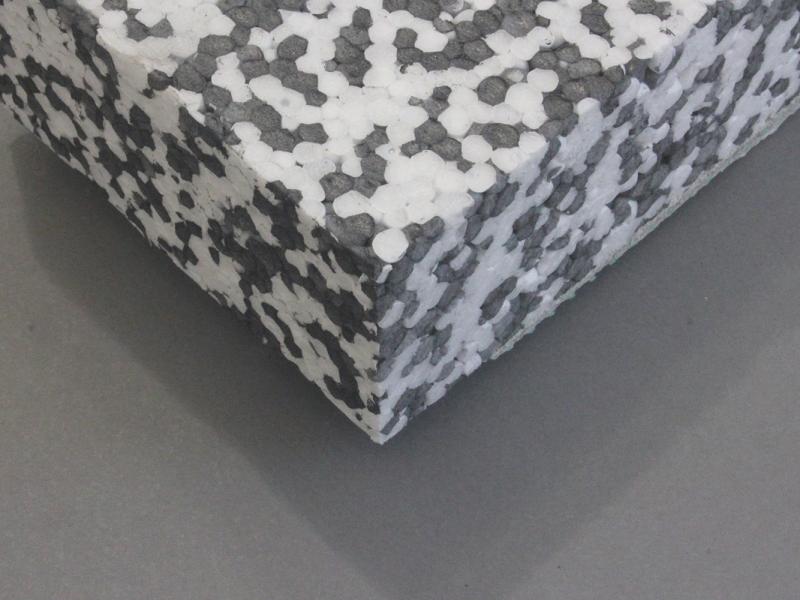
The production of EPS boards takes place in three stages. Firstly, the styrene monomer is polymerised to form polystyrene. The resulting polystyrene granules, containing the co-polymerised blowing agent pentane, are then expanded in the second stage. This takes place at temperatures in excess of 90°C. During this process, also known as pre-expansion, the blowing agent evaporates, causing the material to expand. After temporary storage, the expanded polystyrene beads are filled into moulds and, in the final stage of the process – foaming – are bonded into panels by means of a hot steam treatment.
Technical Specifications
Property | Unit | Parameters | ||
|---|---|---|---|---|
| Thermal conductivity λB | W/(mK) | 0.032 – 0.035 | 0.031–0.035 | 0.031–0.035 |
| Bulk density ρ | kg/m³ | 15–18 | 15–20 | 20–30 |
| Heat capacity c | J/(kgK) | 1500 | 1,500 | 1500 |
| Building material class | -- | B1, B2 | B1, B2 | B1, B2 |
| Water vapour diffusion resistance μ | -- | 20–40 | 30–100 | 30–100 |
| Primary energy content | kWh/m³ | 380–420 | 375–500 | 500–750 |
| Water-repellent effect | -- | yes | yes | yes |
| Can it withstand pressure? | -- | yes | Yes | Yes |
*Comparative U-value: 1.0 W/(m²K)
The panels are 100 per cent recyclable.
The area of application for ETICS (External Thermal Insulation Composite Systems) is not covered by DIN 4108-10 and requires the relevant system approval. This contains all the necessary information and can be obtained from the respective system supplier.
Gesundheit und Ökologie
.Crude oil is used as the raw material for the insulation. Although this tends to be viewed negatively in an environmental assessment due to its limited availability and, in some cases, long transport distances, only small quantities of crude oil are required to produce the insulation. Furthermore, the high energy consumption during production has a negative impact on the life cycle assessment. The flame retardant HBCD, which was used until 2015, has also been classified as environmentally toxic[i]. However, the risk of environmental contamination is considered to be very low or non-existent, as the flame retardant is firmly embedded in the insulation matrix. Since 2016, the flame retardant Polymer-FR has been used, which has been officially classified as safe by the Federal Environment Agency. Another substance of concern is the raw material styrene, which has carcinogenic and neurotoxic effects on humans[ii]. However, once the substance has undergone complete polymerisation, the resulting polystyrene poses no health risk[iii]. It can only be released through chemical decomposition in the event of a fire.
Disposal: Polystyrene is practically non-biodegradable; therefore, if reuse is not possible, the sheets can only be recycled thermally. Construction site offcuts are taken back by the manufacturers, sorted by type. Landfilling of the material is no longer permitted; only thermal recycling
is allowed
[i]www.wecobis.de (accessed on 16 August 2012)
[ii]http://www.bfr.bund.de; Press release 25/2006
- A wide range of applications
- Extensive experience, many manufacturers
- Good insulation properties
- good value for money
- Production is based on crude oil
- high primary energy content