Roof
roof pitch
Drempel
Flat roof
Upper floor slab
Solid ceiling
timber-beamed ceiling
Nail binder
Attic conversion
External wall
Façade
Partition joint in a house
cellar wall
Ground floor
cellar ceiling
Stairway to the cellar
Solid ceiling
Cap ceiling
Timber joist floor/cavity
Special components
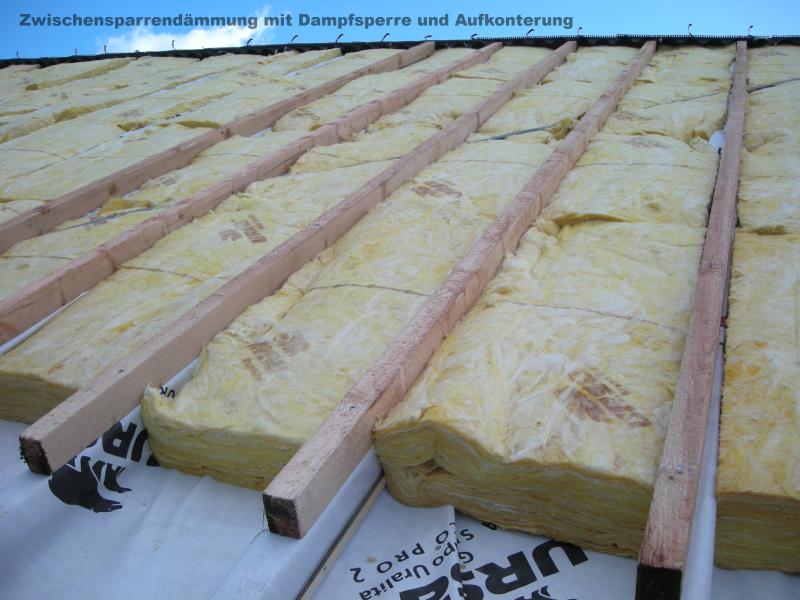
Often, old roofs have only rudimentary insulation. As a result, thermal insulation is extremely poor, heating costs are far too high and, in summer, it becomes unbearably hot in the loft flats. If roofs are to be re-roofed anyway, it therefore makes perfect sense to replace the roof insulation at the same time.
The roofer first removes the old roof covering (roof tiles, battens, any existing membranes) and the (usually) poorly installed insulation. If there is no vapour barrier on the interior side that has been bonded airtight, this is laid in a loop pattern over the old rafters and into the rafter space.
Important: The installation must be airtight, particularly where it joins adjacent structural elements, chimneys, roof windows, etc.
Afterwards, either
- the rafter can be raised outwards using a so-called ‘blind rafter’,
- a ‘rafter expander’ can be installed on the outside
The rafter layer, which is usually 16 cm thick, is fully insulated.


All the benefits at a glance:
Improved thermal insulation: If the so-called heat transfer coefficient (U-value) of the roof is 1.2 W/m²K (watts per square metre and Kelvin) before insulation work is carried out, this can be improved to 0.14 W/m²K. This means the thermal insulation is 9 times better than before.
Lower heating costs: Depending on the type of building and its structural condition, this measure can reduce the building’s heating costs by up to 25 per cent.
Further benefits:
- Draughts are eliminated
- Comfort is improved due to higher temperatures on the inside of the sloping roof surfaces
- Mould disappears
- Summer heat protection is significantly improved
- CO₂ emissions are reduced
- A new, durable roof is created
Costs/cost-effectiveness: Depending on the type of construction, size, complexity and geographical location, this measure can cost up to €350 per m².
Funding: All costs associated with this measure are eligible for a 20 per cent tax deduction or, under the BEG (Federal Funding Scheme for Efficient Buildings), for a grant of up to 20 per cent (as part of an individual renovation roadmap, iSFP) of the total costs in the form of an investment grant.
The BEG funding scheme is administered by the Federal Office for Economic Affairs and Export Control (BAFA). To receive the funding, you must engage a qualified energy efficiency expert before work begins. Further information:
Can I carry out the insulation work myself? No. You may assist with the work. Please contact your specialist contractor for this.
Insulation materials:
Rafter insulation: glass wool, rock wool and hemp fibre mats, as well as all types of blow-in insulation
or rock wool, wood fibre and glass wool blow-in insulation materials